
Writing Program Overview
The new writing program for Scholars Online is considerably changed from prior versions. We've found that the existing program has not always been able to take into account varying levels of student expertise, so we've undertaken a considerable overhaul to make it more adaptive. Our goal is for each student to work as efficiently as possible toward personal mastery in all areas of writing, without one student having to slow others.
We are accordingly replacing the three-tiered sequence of "Writing for the College-Bound" classes with a single asynchronous program comprising a number of discrete topical units, each of which can be invoked once or several times as the student needs it. Rather than having regular real-time class meetings, students will progress through the writing units. The result will be a course that engages an ongoing diagnostic process and thereby generates an individually tailored program to address that student's needs, and proceeding at that student's own pace. Teachers will be available online from time to time for instant feedback, in an “office hours” model.
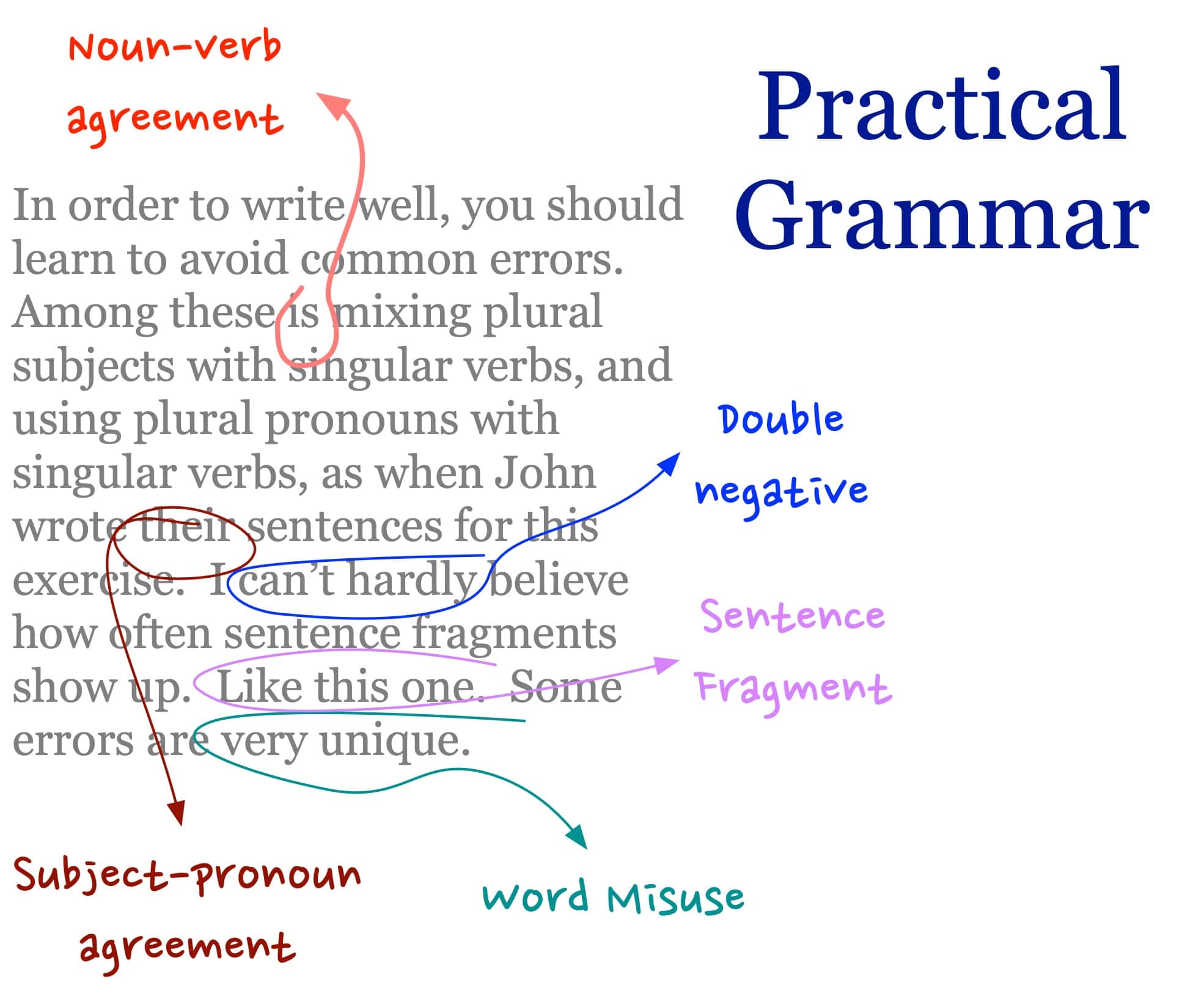
The units are clustered roughly according to the principles of the classical trivium — grammar, dialectic, and rhetoric. The first will address two areas, chiefly — grammar proper (the organization of sentences, clauses, and their proper relation to one another), and conventional mechanics (punctuation, capitalization, italics, etc.). If a student is fully in command of these, he or she can move on; if only one or two areas require special attention, those can become the student's focus until they are mastered, rather than everyone having to march through a fixed sequence of units, irrespective of mastery. From there the student will proceed to the dialectic stage — the construction of arguments and orderly disclosure of information. It will address answering the right question, writing clear definitions and explanations, providing supporting material, and avoiding defective modes of argumentation. Finally, the rhetoric stage will introduce the student to the nuances of elegant and precise expression, tailoring an argument to a given audience, and so on. Throughout the process, however, the stages lower on the ladder, so to speak, will remain available for remediation on a case-by-case basis as needed, and will be periodically checked by diagnostic means.
Our intent is to construct the most rigorous writing curriculum possible. Hence our devotion to detail in mundane areas which might otherwise pass overlooked, and hence our significant expectations for the higher levels. At one end of this program, students must demonstrate knowledge and mastery of clause structure, a subject long ago abandoned by most schools; at the other, students aspiring to the highest achievement of the course must complete at least one research paper of 10,000 words—and submit it for publication somewhere.
In what may seem an edgy and radical departure for our normally rather staid approach to education, we're framing all this in the format of a game. The game story is social and political advancement in ancient Rome. The student controls a character who begins as a student and climbs, through various exercises, the hierarchy of Roman offices. The game is non-competitive and non-combative; it pits students against the rigorous demands of the game itself, not against each other.
"Gamification" has become a buzz-word in current educational dialogue, and sometimes it's not clear that it's useful. Theorists now assert that if the game rewards what you're actually trying to teach, it will be successful; if not, it's a distraction. Here's why we think our game will succeed:
First and foremost, the game approach encourages ongoing and continuous self-evaluation and remediation of trouble areas as they come to light. This has been the most constant deficiency we have ourselves perceived in the class-based program we've had in place to date. Removing the lock-step class schedule helps, but requires that the classes be replaced with some other structure to ensure that all students keep working toward a goal—hence the achievements and objectives of the game. We believe that this presentation will uphold and enhance the current level of skill-building of the program.
Second, we admit that not all students find grammar and syntax as rapturously engaging as we do, but we've come to accept it. We hope they'll come around, but through the game we are trying to provide a little extra excitement.
Third, the game will provide a bit of a view into Roman history along the way. Both Mr. Christiansen and Dr. McMenomy teach history, and it's dear to both our hearts. Furthermore, familiarity with the titles and offices of ancient Rome should assist any students also taking Latin or World History courses.
We're sure many of you will have questions about both approach and content. We welcome further questions and inquiries directly: contact Mr. Christiansen and Dr. McMenomy.
If you would like to see a couse not yet listed, please use the EMAIL US link below to contact Scholars Online Administration with your course request.
Students who were enrolled in courses from previous years will find the teacher, text, and course description information available from the student's unofficial transcript, which can be reached from the parent's Account Management Center, or from an alumni's own Account Management Center.
To see details about an individual course, click on the black triangle to the left of the course name
 |
Molding Your Argument • 2012 listing - for reference only • Grade 8 or above • [Summer course]
| |
|
Primary Instructor
| |
|
|
Sections [Enrolled students will be notified if teacher schedules change between course posting at the time enrollment opens and the scheduled start of classes. Please see Tuition and Fees for refund policy.]
| |
| | Section 1 Instructor: Bruce McMenomyClasses meet from June 13, 2012 to August 8, 2012Wednesday 11:00 AM to 12:30 PM ETTuition: $150.00
|
|
|
Website
| |
| | There is currently no teacher website for this course.
|
|
|
Description
| |
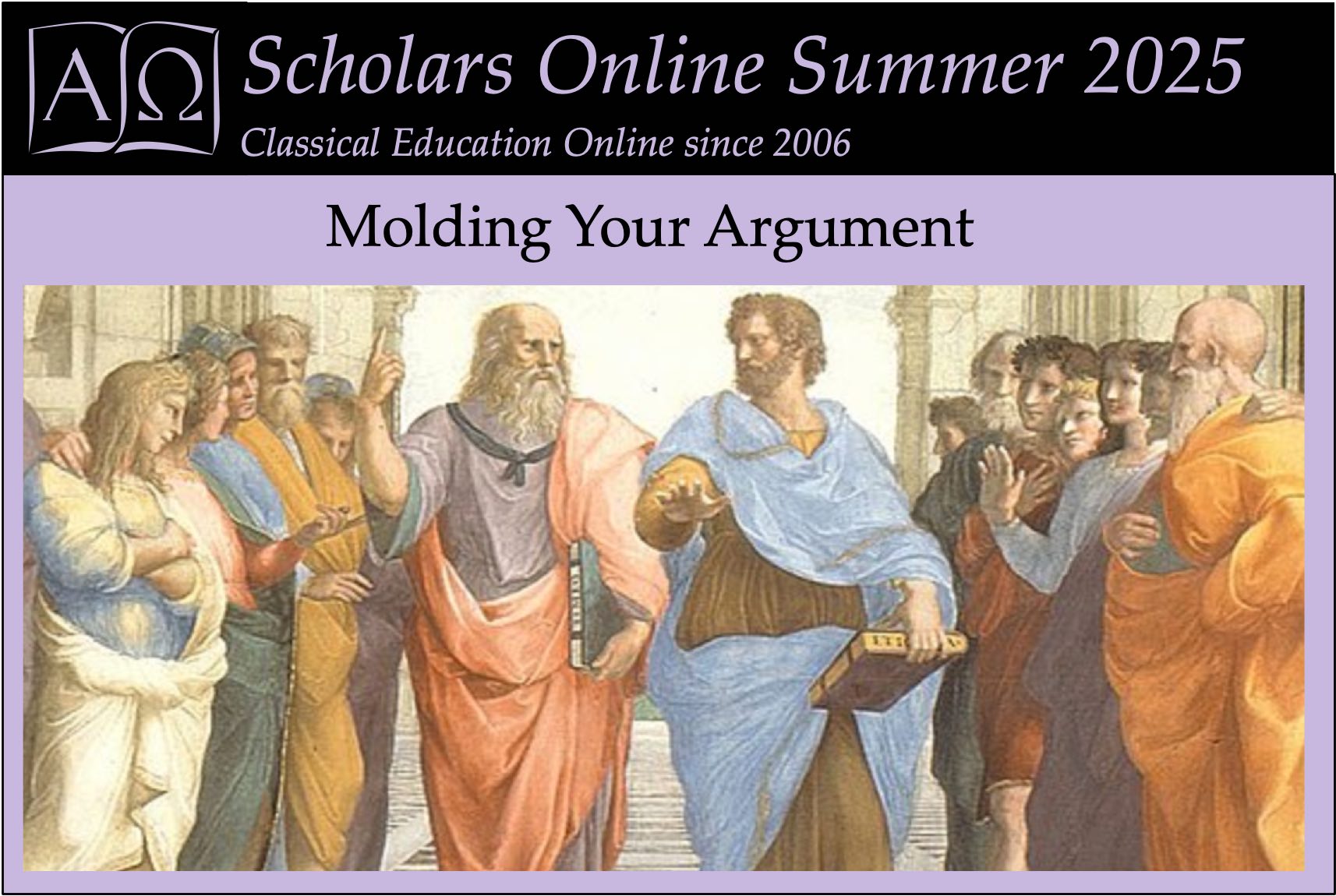
| | Modeled on "Molding Your Prose", this course involves developing a sequence of arguments from the same topics by varying their structure to correspond to a range of pre-defined forms, from simple thesis statements and simple paragraphs, through the five-paragraph essay, the Thomistic scholastic model, and the Roman rhetorical outline applied by Cicero and his contemporaries.
|
|
|
Meetings
| |
| | This course meets once a week for discussion and review of assigned homework.
|
|
|
Homework
| |
| | At the beginning of the summer, each student selects a controversial position on which he or she will be willing to argue both sides. We therefore tend to exclude morally volatile issues. Each week, students present their arguments from one side or another of the question, according to the formula for that week, and post them on the class bulletin board. They then prepare critiques of each other's work in round-robin fashion, and discuss how each work fulfills the demands of the form.
|
|
|
Prerequisites
| |
| | None, though this course naturally builds on "Molding Your Prose". The course may be re-taken with profit.
|
|
|
Recommended background
| |
| | Some familiarity with writing about expository matters is useful, but not required.
|
|
|
Instructor's Notes
| |
| | No materials are required for this course. The course has been offered to enthusiastic classes for three years previously.
|
|
 |
Textbooks and Materials
| |
|
There are no textbook or materials currently required for this course.
| |
| | Check instructor's notes above for additional information, or contact the instructor.
|
|
 |
Molding Your Prose • 2012 listing - for reference only • Grade 7 or above • [Summer course]
| |
|
Primary Instructor
| |
|
|
Sections [Enrolled students will be notified if teacher schedules change between course posting at the time enrollment opens and the scheduled start of classes. Please see Tuition and Fees for refund policy.]
| |
| | Section 1 Instructor: Bruce McMenomyClasses meet from June 12, 2012 to August 17, 2012Tuesday 11:00 AM to 12:30 PM ETTuition: $150.00
|
|
|
Website
| |
| | There is currently no teacher website for this course.
|
|
|
Description
| |
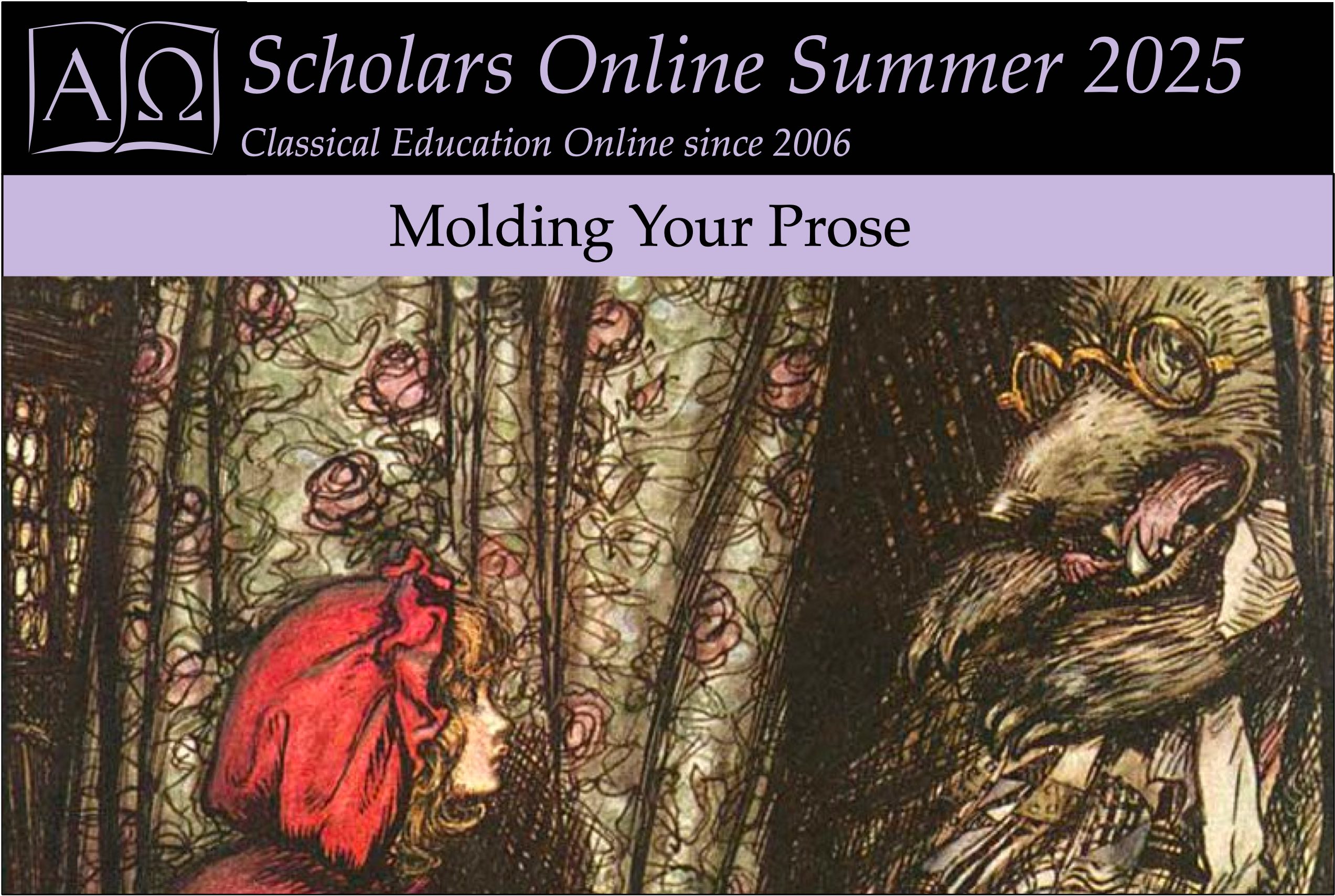
| | This course fosters familiarity with the writing process by asking the student to write a sequence of exercises based on the same basic narrative material. Along the way, students learn that written material does not steer itself: it can be adapted almost infinitely to a variety of forms and requirements. In this respect, it is an introduction to both other writing courses and to literary study.
|
|
|
Meetings
| |
| | This course meets once a week for discussion and review of assigned homework.
|
|
|
Homework
| |
| | At the beginning of the summer, each student chooses a simple story, like a fairy tale or a classic fable. Each week throughout the course, he or she rewrites the story according to a different set of criteria, and posts it to the bulletin board for the course. Students are assigned one other student's story each week to review for the next week's discussion in class, on a round-robin basis so that, over the course of the summer, most students have reviewed most other students' work.
|
|
|
Prerequisites
| |
|
|
Recommended background
| |
| | Any previous writing experience would be helpful, though advanced writers might profit more from another course in the "Molding Your..." sequence
|
|
|
Instructor's Notes
| |
| | "Molding Your Prose" has served as an introductory writing course, and an introduction to Dr. McMenomy's courses for the last fifteen years.
No materials are required for this course.
|
|
 |
Textbooks and Materials
| |
|
There are no textbook or materials currently required for this course.
| |
| | Check instructor's notes above for additional information, or contact the instructor.
|
|
 |
Molding Your Style • 2012 listing - for reference only • Grade 10 or above • [Summer course]
| |
|
Primary Instructor
| |
|
|
Sections [Enrolled students will be notified if teacher schedules change between course posting at the time enrollment opens and the scheduled start of classes. Please see Tuition and Fees for refund policy.]
| |
| | Section 1 Instructor: Bruce McMenomyClasses meet from June 13, 2012 to August 8, 2012Wednesday 4:00 PM to 5:30 PM ETTuition: $150.00
|
|
|
Website
| |
|
|
Description
| |
| | "Molding Your Style" introduces students to the almost inexhaustible range of possibilities for stylistic manipulation, by recasting a given source passage (about a page) into the style of one or another of the great stylists of the English language. Along the way they learn some of the tools of stylistic analysis and criticism, as well as ways of recasting their writing to create different moods and effects. The course is accordingly good preparation for both writing and critical literary study.
|
|
|
Meetings
| |
| | This course meets once a week for discussion and review of assigned homework.
|
|
|
Homework
| |
| | At the beginning of the summer, each student selects one source passage from a list provided; each week he or she recasts that passage in the style of the author of the week, and posts the resulting exercise to the bulletin board for the class. Students write extended critiques of each other's work throughout the summer; depending on the size of the class, students may be asked to write on all the other students' work, or just one or two.
|
|
|
Prerequisites
| |
| | No formal prerequisite, but some awareness of prose style as a deliberate and controlled phenomenon is essential. It is highly recommended that the student have taken at least some literature course.
|
|
|
Recommended background
| |
| | Builds naturally on "Molding Your Prose" and "Molding Your Argument"; almost any background in literary reading and writing is likely to prove beneficial, and it is probably particularly suitable to those who are pursuing creative writing generally. Students have taken the course several times with profit.
|
|
|
Instructor's Notes
| |
| | No external materials required.
|
|
 |
Textbooks and Materials
| |
|
There are no textbook or materials currently required for this course.
| |
| | Check instructor's notes above for additional information, or contact the instructor.
|
|
 |
Introduction to Writing for the College-bound • 2012 listing - for reference only • Grade 7 or above
| |
|
Primary Instructor
| |
|
|
Sections [Enrolled students will be notified if teacher schedules change between course posting at the time enrollment opens and the scheduled start of classes. Please see Tuition and Fees for refund policy.]
| |
| | Section 1 Instructor: Paul ChristiansenClasses meet from September 5, 2012 to May 29, 2013Wednesday 1:30 PM to 3:00 PM ETTuition: $400.00
|
|
|
Website
| |
|
|
Description
| |
| | This introductory course focuses mostly on drafting and revision -- or in other words, getting the words down, and then getting the words right. Taught in conjunction with the similar but more advanced Writing for the College-Bound, we shall proceed from pre-writing and getting ideas, through drafting with various purposes, to revision, and finally to forms of style. For a complete syllabus, see the combined College-Bound Writers website listed above.
|
|
|
Meetings
| |
| | This course meets once a week for discussion and review of assigned homework.
|
|
|
Homework
| |
| | Homework involves weekly writing assignments, the most intensive being drafting essays from scratch and extensive rewriting. This will be a lot of work! The course is focused on the process and on teacher feedback, however, so the majority of the assignments are credit/no credit, and the final assignment is designed to have heavy instructor support throughout.
|
|
|
Prerequisites
| |
|
|
Recommended background
| |
| | No special background required.
|
|
|
Instructor's Notes
| |
| | The combined College-Bound Writers courses (both this class and the standard level) have a combined enrollment minimum of five students -- i.e., if one class has three and another two, then they will both be taught. This minimum is hard and fast, unfortunately, but we hope enrollment will not be a problem.
|
|
 |
Textbooks and Materials
| |
|
There are no textbook or materials currently required for this course.
| |
| | Check instructor's notes above for additional information, or contact the instructor.
|
|
 |
Writing for the College-bound • 2012 listing - for reference only • Grade 9 or above
| |
|
Primary Instructor
| |
|
|
Sections [Enrolled students will be notified if teacher schedules change between course posting at the time enrollment opens and the scheduled start of classes. Please see Tuition and Fees for refund policy.]
| |
| | Section 1 Instructor: Paul ChristiansenClasses meet from September 5, 2012 to May 29, 2013Wednesday 1:00 PM to 3:00 PM ETTuition: $400.00
|
|
|
Website
| |
|
|
Description
| |
| | It has been said that the first draft of anything can be terrible; the real work is in good rewriting. With that in mind, Writing for the College-Bound focuses mostly on the process of revision. After an initial unit on drafting, students will select one essay and, over the course of the year, revise it roughly twenty times, in twenty different ways, before handing it in at the end of the year. The aim is to reach near-professional levels of revision and editing while learning different techniques in the process. For a full syllabus, please see the website listed above. This class is taught in combination with Introduction to Writing for the College-Bound; the two differ primarily in workload.
|
|
|
Meetings
| |
| | This course meets once a week for discussion and review of assigned homework.
|
|
|
Homework
| |
| | This class will require significant effort. While students will, for the majority of the year, be working on a single core essay, the amount of revision required every week is extensive. However, the majority of the individual assignments are credit/no-credit, with only the core essay receiving a true grade at the end of the year. If the students can do the work, they'll do well in the course.
|
|
|
Prerequisites
| |
| | Introduction to Writing for the College-bound or equivalent course or experience. Exceptions can certainly be made, but some evidence of a student's ability to keep pace with the rigorous schedule will be required.
|
|
|
Recommended background
| |
| | Students should have at least a year's worth of experience in writing essays.
|
|
|
Instructor's Notes
| |
| | This course and its companion Introduction to Writing for the College-Bound have a combined minimum enrollment of five students -- i.e., if one class has two students and the other has three, both will be taught. This limit is hard and fast, unfortunately, but we hope enrollment will not be a problem.
|
|
 |
Textbooks and Materials
| |
|
The Elements of Style William Strunk, Jr., E.B. White
| |
| | This text is recommended; purchase and use is optional. ISBN: 020530902X Best sources: Scholars Online Bookstore
|
|
 |
Advanced Writing for the College-bound • 2012 listing - for reference only • Grade 8 or above
| |
|
Primary Instructor
| |
|
|
Sections [Enrolled students will be notified if teacher schedules change between course posting at the time enrollment opens and the scheduled start of classes. Please see Tuition and Fees for refund policy.]
| |
| | Section 1 Instructor: Bruce McMenomyClasses meet from September 6, 2012 to May 30, 2013Thursday 9:00 AM to 10:30 AM ETTuition: $420.00
|
|
|
Website
| |
|
|
Description
| |
| | This course builds on the lessons learned in Writing for the College-bound, focusing primarily on organizational elements of expository writing.
|
|
|
Meetings
| |
| | This course meets once a week for discussion and review of assigned homework.
|
|
|
Homework
| |
| | The homework for the course will involve completion of weekly assignments: there is normally one new assignment every other week, with the intervening week being used for rewriting. At both stages of the process, student papers are available for peer review.
|
|
|
Prerequisites
| |
| | Students should have taken Writing for the College-bound, an equivalent course, or have equivalent writing experience. If there are doubts about appropriate preparation, please contact the instructor.
|
|
|
Recommended background
| |
| | As the title suggests, this is a more advanced course, and hence it presupposes that students are already fairly capable writers and astute readers.
|
|
 |
Textbooks and Materials
| |
|
There are no textbook or materials currently required for this course.
| |
| | Check instructor's notes above for additional information, or contact the instructor.
|
|
 |
Cursus Scriptorum: Writing With Honors • Offering for 2013 • Grade 6 or above
| |
|
Primary Instructor
| |
|
|
Sections [Enrolled students will be notified if teacher schedules change between course posting at the time enrollment opens and the scheduled start of classes. Please see Tuition and Fees for refund policy.]
| |
| | Section 1 Instructor: Paul ChristiansenClasses meet from September 1, 2013 to June 30, 2014Dates and times to be arranged with enrolled students.Tuition: $450.00
|
|
|
Website
| |
|
|
Description
| |
| | The Cursus Scriptorum is the new Scholars Online writing program: designed to be as rigorous and comprehensive as possible, following an innovative individualized process, and taking the form of an academic game. The course is asynchronous, to allow students to proceed at their own pace and to allow those with crowded schedules to enroll. Teachers will be available online in "office hours" for immediate feedback. See the course page for more information.
|
|
|
Meetings
| |
| | Please contact instructor for information on how often the course will meet online in chat.
|
|
|
Homework
| |
| | Work is contained in units. Students can drill through these units as many times as need be, so largely speaking the workload is up to them.
|
|
|
Prerequisites
| |
|
|
Recommended background
| |
| | No special background required.
|
|
|
Instructor's Notes
| |
| | This course is very much in the process of being designed. Further details shall be forthcoming as soon as they have been invented and assessed.
|
|
 |
Textbooks and Materials
| |
|
There are no textbook or materials currently required for this course.
| |
| | Check instructor's notes above for additional information, or contact the instructor.
|
|
 |
Creative Writing • Offering for 2013 • Grade 8 or above
| |
|
Primary Instructor
| |
|
|
Sections [Enrolled students will be notified if teacher schedules change between course posting at the time enrollment opens and the scheduled start of classes. Please see Tuition and Fees for refund policy.]
| |
| | Section 1 Instructor: Krista AlsopClasses meet from September 5, 2013 to May 29, 2014Thursday 5:30 PM to 6:30 PM ETTuition: $450.00
|
|
|
Website
| |
| | There is currently no teacher website for this course.
|
|
|
Description
| |
| | The Creative Writing course is a space to explore and enjoy the craft of writing. Just as a musician lays a technical foundation through scales and etudes, we will strengthen our muscles through a series of daily writing exercises. We will organize our forays into three units: poetry, nonfiction, and fiction, while challenging the boundaries between these areas (what makes a poem a poem? how is nonfiction a craft? what makes fiction nonetheless true?).
The hardest part of writing may be to read and revise one’s work dispassionately, so that it speaks clearly outside of the self; thus, in class and forum, students will help one another to hear and hone their own voice through workshop discussions of each other’s work. Along the way, students can expect to muck about with words, encounter dazzling works of art, and enjoy the rich solitude and lively community of writing.
|
|
|
Meetings
| |
| | This course meets once a week for discussion and review of assigned homework.
|
|
|
Homework
| |
| | The course’s daily writing commitment is a 30-minute minimum. Students are encouraged to find a time block that works consistently throughout the week to establish a writing rhythm (this may require some experimentation for the first week or two). Students will also participate in a Moodle forum, which will involve posting a piece of their work and thoughtfully responding to a peer’s offering, or taking a quiz covering a class or reading topic, or contributing to a forum discussion. Course readings will be assigned weekly, although compared to the Literature sequence, the load is light, as this course emphasizes crafting time and peer review. Students can expect to spend approximately one hour a day on the course.
|
|
|
Prerequisites
| |
| | This course has no prerequisites.
|
|
|
Recommended background
| |
| | Wide reading across varied genres is helpful, as is any previous writing experience (academic or creative), but no particular background is required. The developing writer brings to the table all of her previous reading, writing, and living. No writer is too experienced to grow, nor too inexperienced to begin. Coursework is designed with the high school writer in mind, although the junior high school student may also benefit.
|
|
 |
Textbooks and Materials
| |
|
A Poetry Handbook (Edition: 1) Mary Oliver
| |
| | This text is required. ISBN: 9780156724005 Best sources: Scholars Online Bookstore
|
|
|
An Exaltation of Forms: Contemporary Poets Celebrate the Diversity of Their Art (Edition: 1) Annie Ridley Crane Finch, Katherine Lore Varnes
| |
| | This text is required. ISBN: 9780472067251 Best sources: Scholars Online Bookstore Other information: While the book has been in and out of print, used copies are readily available through Amazon and other vendors.
|
|
|
Mystery and Manners: Occasional Prose (Edition: 1) Flannery O'Connor (author), Sally Fitzgerald (ed), Robert Fitzgerald (ed)
| |
| | This text is required. ISBN: 9780374508043 Best sources: Scholars Online Bookstore
|
|
|
The Norton Reader: An Anthology of Nonfiction (Edition: 11) Linda Peterson, John C. Brereton
| |
| | This text is required. ISBN: 9780393978872 Best sources: Scholars Online Bookstore Other information: The 11th, 12th or 13th editions (full length, not the "shorter" printings) are fine. Please contact the instructor if you have an earlier edition you wish to use.
|
|
|
The Norton Anthology of Poetry (Edition: 5) Margaret Ferguson, Mary Jo Salter, Jon Stallworthy
| |
| | This text is recommended; purchase and use is optional. ISBN: 9780393979206 Best sources: Scholars Online Bookstore Other information: During the Fall poetry unit, in addition to assigned readings from the required texts, students will read independently in an anthology of their choice. Library exploration is encouraged and this text is presented by way of example. Any anthology of poetry written originally in English is acceptable. Poetry-in-translation (cf. Norton's lovely World Poetry anthology) is outside the scope of this course.
|
|
 |
Molding Your Prose • Offering for 2013 • Grade 7 or above • [Summer course]
| |
|
Primary Instructor
| |
|
|
Sections [Enrolled students will be notified if teacher schedules change between course posting at the time enrollment opens and the scheduled start of classes. Please see Tuition and Fees for refund policy.]
| |
| | Section 1 Instructor: Bruce McMenomyClasses meet from June 18, 2013 to August 13, 2013Tuesday 11:00 AM to 12:30 PM ETTuition: $200.00
|
|
|
Website
| |
| | There is currently no teacher website for this course.
|
|
|
Description
| |
| | This course fosters familiarity with the writing process by asking the student to write a sequence of exercises based on the same basic narrative material. Along the way, students learn that written material does not steer itself: it can be adapted almost infinitely to a variety of forms and requirements. In this respect, it is an introduction to both other writing courses and to literary study.
|
|
|
Meetings
| |
| | This course meets once a week for discussion and review of assigned homework.
|
|
|
Homework
| |
| | At the beginning of the summer, each student chooses a simple story, like a fairy tale or a classic fable. Each week throughout the course, he or she rewrites the story according to a different set of criteria, and posts it to the bulletin board for the course. Students are assigned one other student's story each week to review for the next week's discussion in class, on a round-robin basis so that, over the course of the summer, most students have reviewed most other students' work.
|
|
|
Prerequisites
| |
|
|
Recommended background
| |
| | Any previous writing experience would be helpful, though advanced writers might profit more from another course in the "Molding Your..." sequence
|
|
|
Instructor's Notes
| |
| | "Molding Your Prose" has served as an introductory writing course, and an introduction to Dr. McMenomy's courses for the last fifteen years.
No materials are required for this course.
|
|
 |
Textbooks and Materials
| |
|
There are no textbook or materials currently required for this course.
| |
| | Check instructor's notes above for additional information, or contact the instructor.
|
|
 |
Molding Your Argument • Offering for 2013 • Grade 8 or above • [Summer course]
| |
|
Primary Instructor
| |
|
|
Sections [Enrolled students will be notified if teacher schedules change between course posting at the time enrollment opens and the scheduled start of classes. Please see Tuition and Fees for refund policy.]
| |
| | Section 1 Instructor: Bruce McMenomyClasses meet from June 19, 2013 to August 14, 2013Wednesday 11:00 AM to 12:30 PM ETTuition: $200.00
|
|
|
Website
| |
| | There is currently no teacher website for this course.
|
|
|
Description
| |
| | Modeled on "Molding Your Prose", this course involves developing a sequence of arguments from the same topics by varying their structure to correspond to a range of pre-defined forms, from simple thesis statements and simple paragraphs, through the five-paragraph essay, the Thomistic scholastic model, and the Roman rhetorical outline applied by Cicero and his contemporaries.
|
|
|
Meetings
| |
| | This course meets once a week for discussion and review of assigned homework.
|
|
|
Homework
| |
| | At the beginning of the summer, each student selects a controversial position on which he or she will be willing to argue both sides. We therefore tend to exclude morally volatile issues. Each week, students present their arguments from one side or another of the question, according to the formula for that week, and post them on the class bulletin board. They then prepare critiques of each other's work in round-robin fashion, and discuss how each work fulfills the demands of the form.
|
|
|
Prerequisites
| |
| | None, though this course naturally builds on "Molding Your Prose". The course may be re-taken with profit.
|
|
|
Recommended background
| |
| | Some familiarity with writing about expository matters is useful, but not required.
|
|
|
Instructor's Notes
| |
| | No materials are required for this course. The course has been offered to enthusiastic classes for almost a decade.
|
|
 |
Textbooks and Materials
| |
|
There are no textbook or materials currently required for this course.
| |
| | Check instructor's notes above for additional information, or contact the instructor.
|
|
 |
Molding Your Style • Offering for 2013 • Grade 10 or above • [Summer course]
| |
|
Primary Instructor
| |
|
|
Sections [Enrolled students will be notified if teacher schedules change between course posting at the time enrollment opens and the scheduled start of classes. Please see Tuition and Fees for refund policy.]
| |
| | Section 1 Instructor: Bruce McMenomyClasses meet from June 19, 2013 to August 14, 2013Wednesday 4:00 PM to 5:30 PM ETTuition: $200.00
|
|
|
Website
| |
|
|
Description
| |
| | "Molding Your Style" introduces students to the almost inexhaustible range of possibilities for stylistic manipulation, by recasting a given source passage (about a page) into the style of one or another of the great stylists of the English language. Along the way they learn some of the tools of stylistic analysis and criticism, as well as ways of recasting their writing to create different moods and effects. The course is accordingly good preparation for both writing and critical literary study.
|
|
|
Meetings
| |
| | This course meets once a week for discussion and review of assigned homework.
|
|
|
Homework
| |
| | At the beginning of the summer, each student selects one source passage from a list provided; each week he or she recasts that passage in the style of the author of the week, and posts the resulting exercise to the bulletin board for the class. Students write extended critiques of each other's work throughout the summer; depending on the size of the class, students may be asked to write on all the other students' work, or just one or two.
|
|
|
Prerequisites
| |
| | No formal prerequisite, but some awareness of prose style as a deliberate and controlled phenomenon is essential. It is highly recommended that the student have taken at least some literature course.
|
|
|
Recommended background
| |
| | Builds naturally on "Molding Your Prose" and "Molding Your Argument"; almost any background in literary reading and writing is likely to prove beneficial, and it is probably particularly suitable to those who are pursuing creative writing generally. Students have taken the course several times with profit.
|
|
|
Instructor's Notes
| |
| | No external materials required.
|
|
 |
Textbooks and Materials
| |
|
There are no textbook or materials currently required for this course.
| |
| | Check instructor's notes above for additional information, or contact the instructor.
|
|
| To enroll in any of the courses listed above, log into your Scholars Online Account Management Center using the login link at the bottom of any page and select the member you wish to enroll. If you do not have an account, you may create one using the Membership and Enrollment link in the SiteMap to the left of any page. |

Scholars Online is accredited by AdvancED and the Northwest Accreditation Commission.
|
Who We Are |
|
|
Fostering Community |
|
|
What We Do |
|
|
Tools |
|
|
Courses Offered |
|
|
Taking Part |
|