
- Home
- How It Works
- Who We Are
- What We Teach
- Join Us!
- Community
- Fun Stuff
- Login
-

History Courses Online
Government Courses Online
Scholars Online History and Government Course Sequence
 |  |  |
Available Courses
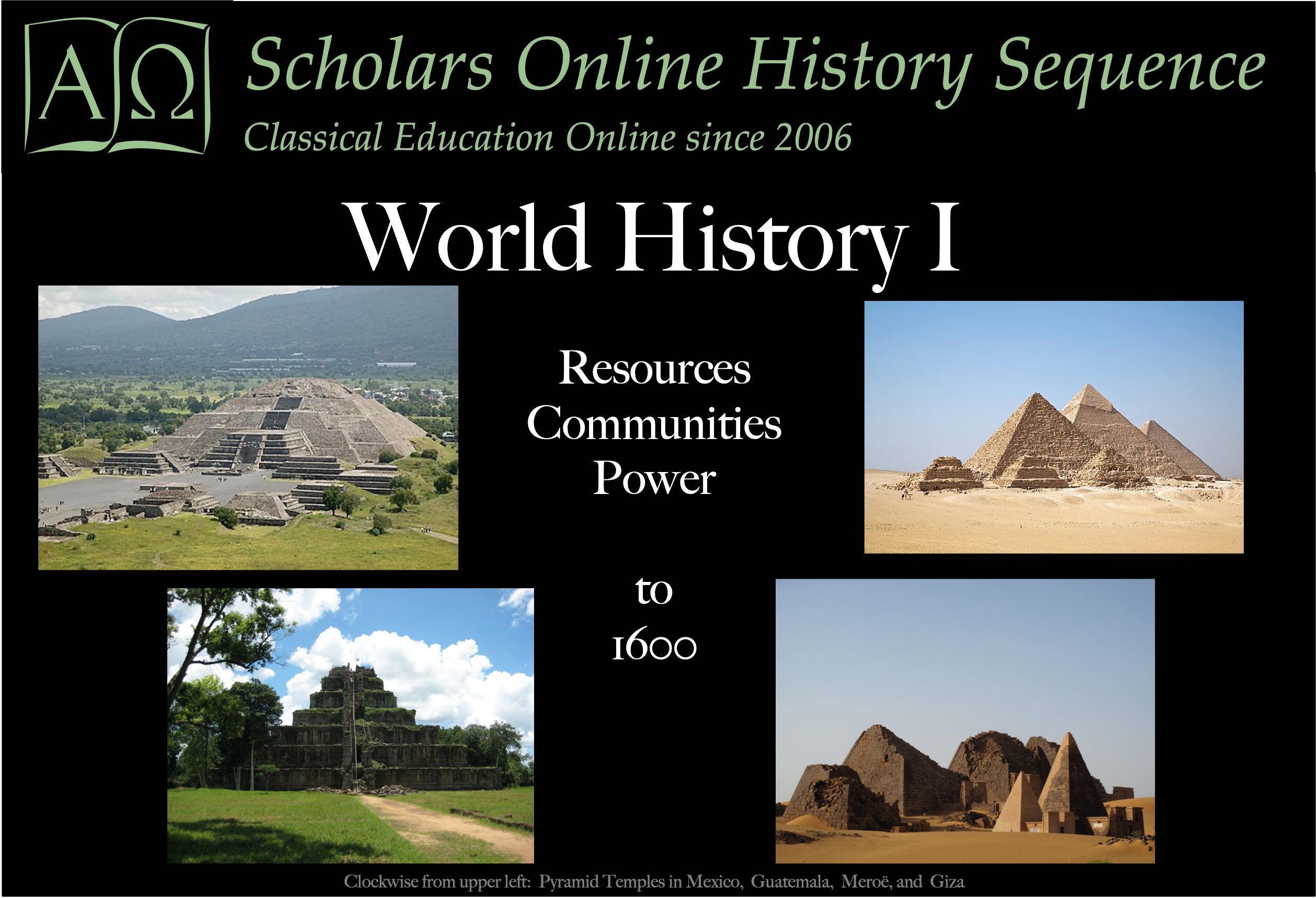
World History I • Academic Year 2026-2027 • Grade 9
Around the World in Nine Weeks • Summer 2026 • Grade 6
To enroll in any of our courses, log into your Scholars Online Account Management Center using the login link at the bottom of any page and select the member you wish to enroll. If you do not have an account, you may create one using the Becoming a Member link under Enrollment in the Navigation bar at the top of this page.
If you are interested in a course not yet offered for this year, please use the EMAIL US link below to contact Scholars Online Administration with your course request.
Scholars Online History Program
History is almost by definition the all-encompassing subject. It has no real boundaries; every human sphere of investigation or endeavor has, just by virtue of continuing through time, acquired a dimension that is historical. Even the most up-to-date things are, insofar as we can talk about them, historical. We can only analyze, interpret, or understand what we’ve already seen or experienced.
History is also the subject about which there is the most potential disagreement. Two people can look at the same actions and events, and come away with radically different conclusions — first, about what happened, but then also about what it meant, and what its continuing significance is or should be. One hears a lot these days about the narrative that governs different perspectives on the world, on politics, and just about everything else. This is a valid concern: how we form a narrative to encompass the various things we understand or think we understand will shape our ability to form intelligent judgments. This is as timely a concern as any we will encounter: in today’s tendentious and embittered political arena, the ability to move beyond our own suppositions, to listen carefully so that we actually understand where someone else is coming from, and to respond thoughtfully but without anger will be essential if we are to address and reconcile the problems and agendas seeking to divide us.
All in all, the challenges of history make for a fantastically rich broth — one so complex that students and teachers do one of two things with it: either they boggle at its extent and ambiguity, and so throw up their hands, or they reduce it to some one-dimensional representation of reality that becomes, as it goes along, a vanishingly useful look at a trivial slice of human experience. Either way, it winds up being perceived as irrelevant, crotchety, and not useful for the problems of tomorrow. Arguably that approach is not even a very good analysis of the problems of yesterday.
Our history program was given its present shape by Mr. Paul Christiansen and Dr. Bruce McMenomy over five years of collaboration and negotiation. They enthusiastically agreed that history is and should be seen as the immediate and real expression of the totality of human experience. History is first and foremost about telling our story: no matter how rarefied it may become, it always centers on looking at events and making sense out of them; analysis and narrative converge to create meaning and understanding. History by nature addresses every problem humanity has ever encountered over the centuries (at least insofar as we can remember them). It confronts us with the successes, failures, and split decisions (mostly those) about how we as people dealt with the problems we faced in the past, and for that very reason it is our only real guide to the problems we confront today, and can expect to confront tomorrow. Beyond that, though, they recognized that no one story or one viewpoint can give a complete picture of our past. Disagreement and dialogue about those things is not merely useful; it’s organic to how the discipline of history works, and how people working together can come together to achieve consensus and a way forward.
The current teachers of our Scholars Online history program continue to pursue this vision. We believe presenting historical material in its complexity and through competing views is the best preparation for our students.
World History I and II
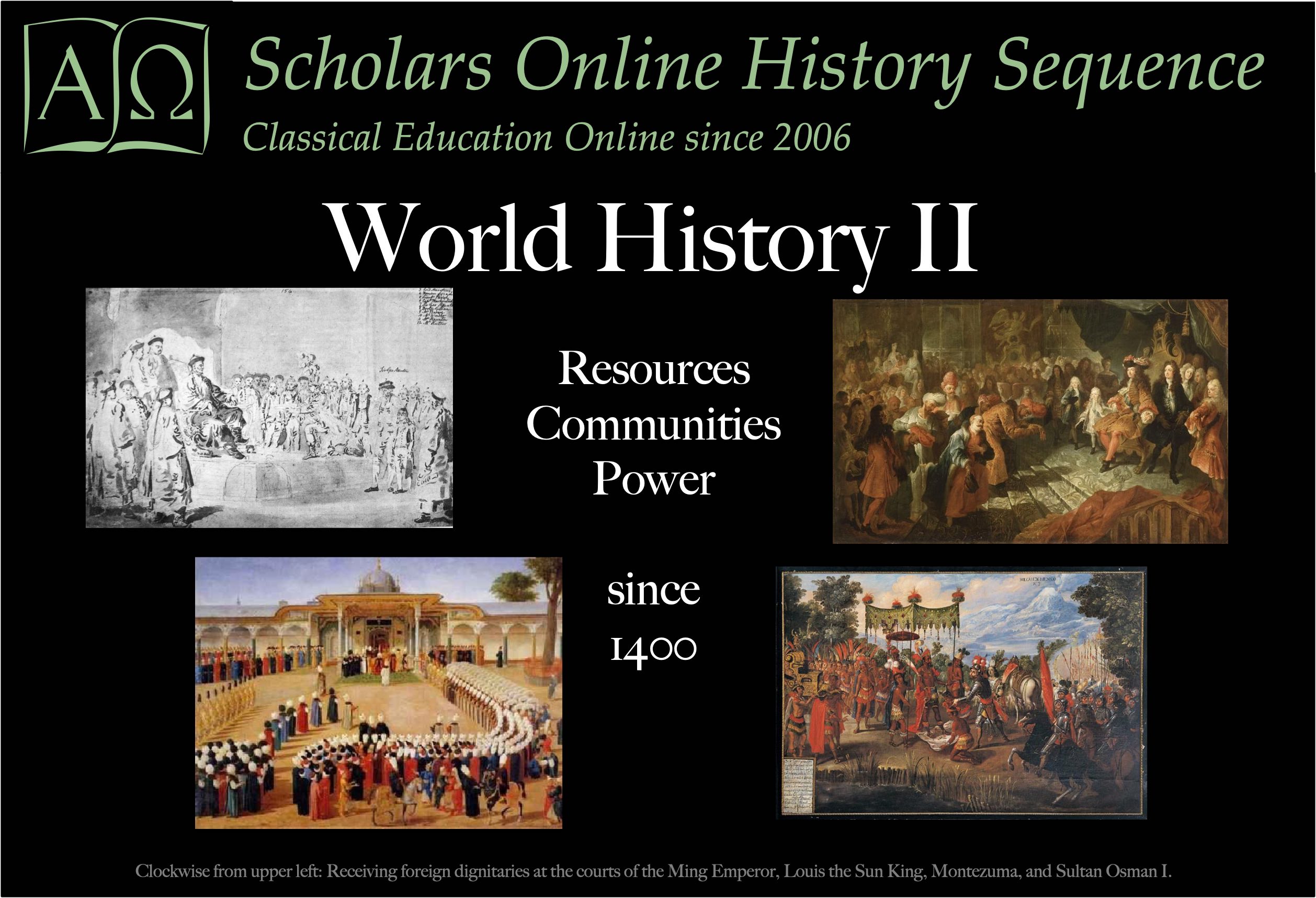
The Scholars Online World History course is team-taught by Dr. Christe and Sarah Miller Esposito. Mrs. Esposito brings to the course a different generational as well as educational perspective. We follow the original structure of the course taught by Dr. Bruce McMenomy and Mr. Paul Christiansen, devoting three sessions per textbook unit to the same areas of discourse that emerge in every age and every society: resources, community, and power. The final session will vary in topic depending on the period and culture under discussion. For this year, we have chosen a textbook which itself has thematic focus on continuity, change, and adoption of innovation. The diversity of these concepts requires us to view events from multiple perspectives, while at the same time applying these categories to each unit allows us to identify useful patterns for investigation and discussion.
Natural Science Years I and II
Strictly speaking, the Natural Science course is taught as part of the science sequence, but it, too, has been formed by the vision we developed for history in general. In its historical component, it addresses the formation and acceptance of scientific theories from different points of view, using multiple internet resources rather than a single text, to help students develop an understanding of how "science" has been defined and practiced since antiquity.
 Scholars Online is fully accredited through the Middle States Accreditation Commissions on Elementary and Secondary Schools.
Hosted on Interserver